Letters
Reprinted from "Crown Jewels of the Wire", March 1996, page 3
MORE ON THE CD 782
The new information on the CD 782 in “The CD 782 - What Is It?”, by
Morgan Davis (January 1996, p. 30) is indeed a great piece of news. Over ten
years ago I obtained some pieces of insulators from the site of the Hamilton
Glass Co. including an aqua Baby Battleford. One of the pieces turned out to be
almost 1/2 of the one side from base to the point where the top was attached of
a CD 782. Unlike the two known specimens (more complete), the piece I have is
emerald green in color. At the time I had no idea what it was, but Ray
Klingensmith being familiar with the one John Dorge had, knew what it was. Last
year I asked the man, who had sold the CD 782 to John, where it had come from.
He explained that he had bought it from a farmer who said he had ploughed it up
on his farm running over it several times before he bothered to pick it up. The
farm was several miles north of London, Ontario, some distance from any railway.
Montreal Telegraph most certainly would have had an office in the town nearby.
The two specimens have M.T.Co. on them but my piece is from the opposite side.
They must have been used in a great number of locations and with more digging at
telegraph office and railway station sites, more should turn up.
Jack Hayes,
Pakenham, Ontario
MY TWO CENTS
I realize my response to John D. Bayes letter (October 1995) is a couple of
months late, but I still wanted to get my two cents in. I kind of have to agree
with him to some point; it sometimes seems that the “halo effect” -- a
display scoring higher in “Showmanship” because it scores high in “Rarity”
does occur, although I don’t think the problem is as bad as he might make it
out to be. But I do have a solution to the problem, one that would be easy to
implement. Simply change the scoring system.
Currently, in the standard NIA 100-point system, Rarity canachieve up to 30
points out of the 100, the same as Education and Showmanship. To solve the
problem John describes, simply make Rarity worth up to 20 points instead of 30,
and those ten points split evenly between Education and Showmanship. (In other
words, make Education and Showmanship worth up to a possible 35 points each.)
Problem solved! I agree with John that education is a very valuable part of an
insulator exhibit. I also enjoy the creativity that has gone into many exhibits.
In other news, a couple months ago, I went to northern California to attend
my brother's 40th birthday party. On the way up, I was able to see Mike Guthrie
and Grant Salzman. I would like to report that both are doing fine and
recovering from various injuries and illnesses and I’m looking forward to
seeing them (and all of you) at the NIA Convention in Long Beach. (At last! A
National I can actually commute to from my house!)
Jim Barton,
Van Nuys, California
Our Man on the Road
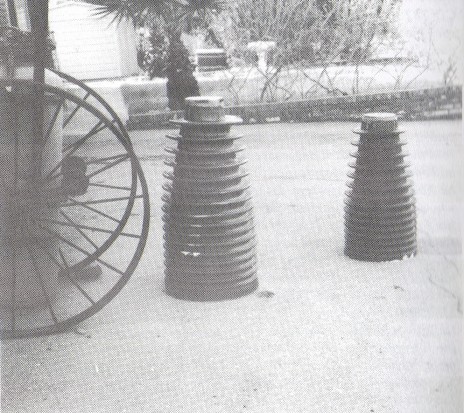
Joe Green of Forney, Texas travels miles and miles of highway during a year
and he sent in this photo of some insulators that are in front of the Ludlow
(California) Motel. The motel has an inviting sign -- "Use the phone and
get a coke!" as well as several of the large porcelain bushings from an old
desert substation. Joe said they are used to “keep the cars from parking on
the lawn of the motel.” Guess they could do it.
Some great pictures from Richard Case of Rockford,
Illinois.
...taken many years ago from a distance without the assistance of a telephoto
lens. You'll get the idea.
 |
 |
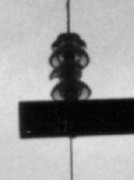
| Top Photo: Hemingray
stackers in service with amber skirts. |
 |
 |
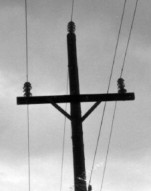
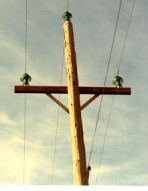
| Middle Photo: Six
Hemingray "O" Provos on one pole. |
 |
 |
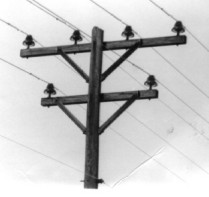
| Bottom Photo: Three
Hemingray Muncies with sleeves. |
64" TALL !!
I thought you would be interested in this insulator. It’s a high voltage
bushing off a big transformer in a substation. I would guess it to have been
manufactured in the 1920’s. It stands 64" from top to bottom with five
skirts.
The body is cone shaped with five skirts that slide over the outside of the
cone and are cemented to the cone. They are different sizes so they can only
slide down the body so far. The bushing is fastened to the transformer by 20
bolts at the base of the bushing. It is oil filled and the cable comes up
through to the center of a big brass bushing on top, which has two eyes for
lifting and dead ending a high voltage line to the fitting.
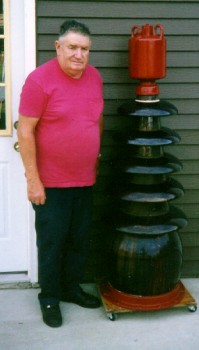
The plate at the bottom of the insulators reads:
The Ohio Brass Co.
Mansfield Barberton Ohio
Voltage 175000
Type ODOF
No. 29120
Corbin Tillman, Brownsburg, IN
| 


)
)
)
)
)
)
)
)