Foreign Insulators
By Curtis Erickson
Reprinted from "Crown Jewels of the Wire", May 2003, page 12
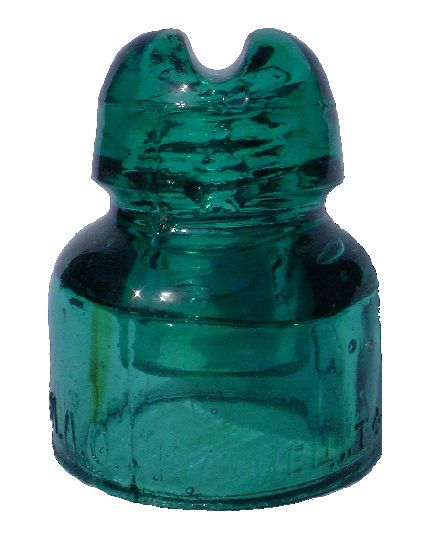
Finding the Russian CD 570.2
Several unique insulators have recently been discovered in Russia. Before
1991 very few Russian insulators had been found, due to the "iron
curtain" . One insulator that has recently been found is the CD 570.2. It
only appeared within the last two years and is a favorite of mine. I found this
in a search for insulators on ebay. The seller, who lived close to me, had some
Russian insulators (CD 540 and CD 541) for sale. I won one of the auctions and
asked the seller, Ken, if I could pick up the insulator at his house. I was
hoping Ken might have more insulators for sale. Luckily he did!
When I went to
Ken's house I immediately bought a couple of insulators. He then showed me
another insulator. I had never seen anything like it. We worked out a deal and I
purchased it. A month later at the Springfield Insulator Show, I showed Marilyn
Albers this new insulator I found. She really liked it, and ended up going home
with it.
Fortunately Ken traveled back to Russia a couple of months later and
was able to find a couple more. There are now a total of seven known, but one is
still in Russia. The one in Russia is still in service. Ken said that there are
no more to be found as he has looked all over the small Russian town of
Yoshkar-Ola. This town is north of Kazan, which is about 500 miles east of
Moscow.
When Ken was in Russia, he was able to find out a little information
about the CD 570.2 insulator. The company that made the insulator apparently
went out-of-business before World War 2. The company closed because of Stalin's
collectivization of farms and private industry. Thus the small private company was doomed to close.
The embossing on the insulator is
most likely just mold numbers or some other kind of code for the insulator
manufacturer. The one word, "Mapneu," is translated to "Mareetz."
Mareetz is the name for a native of the Republic of Mari-el. This is where the
insulator was found in the former Soviet Republic.
Ken told me that the
insulator was actually used on electrical lines instead of telegraph or
telephone lines. He said that the insulator was used on a wooden pin but that
there was hemp between the pin and insulator to give it a tight fit.
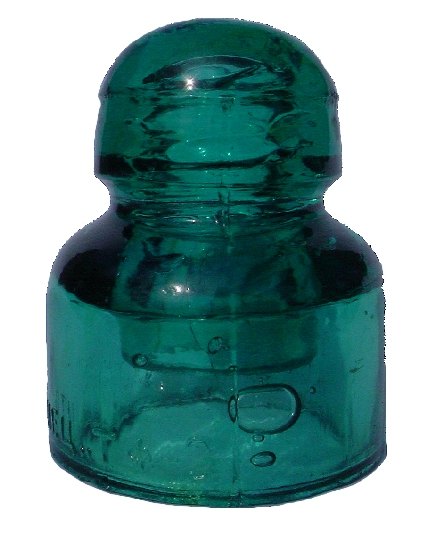
The CD
570.2 has been found in blue and aqua tones. Some colors are lighter and some
darker. The glass seems to be free of impurities except a couple have been found
with some bubbles and amber swirling. The insulator is made of a four-piece mold
which I have never seen on a Russian insulator before.
|