OPINION
Reprinted from "Crown Jewels of the Wire", September 2003, page 28
NIA Board's Report to the General Membership Regarding the
Results of its
Investigation into Imitation EC&M Insulators
by Steve Marks, NIA Past
President
For the past seven years or so, serious questions have been raised about the
authenticity of a group of insulators that have surfaced on the West Coast. The
insulators in question include unembossed CD 735s, dramatic new colors of CD 120
CEWs and CD 123 EC&Ms, and a new style of glass block which has come to be
known as the "Sierra Block." A "Dealer" (whose name is being
withheld by the NIA because there are ongoing civil and criminal
investigations), introduced many of these pieces into the hobby at various
insulator and insulator related shows.
From the beginning the NIA's
Authentication & Classification Committee (hereinafter referred to as
the" A&C Committee"), and the Dealer had an ongoing dialogue about
these new finds and the Dealer was well aware that the NIA had questions as to
their authenticity. The Dealer challenged the NIA on several occasions to prove
that these pieces were fake. Several collectors had spent tens of thousands of
dollars on these pieces. The uncertainty as to the authenticity of these items
has been the source of great anxiety among insulator collectors over the past
five years. Even collectors who did not purchase these specific items were
concerned that someone had the ability to counterfeit insulators and thus damage
the hobby. At the request of its members, the NIA undertook an investigation
into these items in an attempt to determine their authenticity. The NIA's
A&C Committee performed the majority of this work. The investigation has
been costly and quite time consuming.
The first phase of the investigation began
in 2000 and 2001 with the "Sierra Blocks" (the details of that
investigation were published in the Spring 2002 issue of "Drip
Points"). The results of that investigation led the NIA Board to form an
opinion and belief that the "evidence of authenticity" offered by the
Dealer to the A&C Committee regarding the "Sierra Blocks," was a
complete fabrication. The NIA Board decided to confront the Dealer on January
22, 2002. The NIA alleged that the Dealer had committed an act that was
"objectionable to the best interests of the hobby."
"'Objectionable to the best interests of the hobby" as defined under
the NIA's Code of Ethics, "includes, but is hot limited to, any action or
item which is likely to cause financial damage and/ or loss, ill will, or injury
to collectors or organizations involved in the collecting of insulators and
related items. For example, a false or misleading representation of fact likely
to cause confusion, and/or the possibility of the use of an insulator to commit
fraud (either by the issuing party or through a subsequent party)."
The NIA
further alleged that the Dealer had violated various provisions of the NIA Code
of Ethics, including the provision that prohibits NIA Members from
manufacturing, advertising, exhibiting or introducing into the hobby for
distribution (through buying, selling or trading), any imitation insulator that is not plainly and permanently marked "reproduction"
with the calendar year in which such item was manufactured. "Imitation
Insulators" are ones that purport to be, but in fact are not, Original
Insulators. This category includes but is not limited to reproductions, copies,
replicas, or counterfeits of Original Insulators. The Board also had concerns
that the Dealer had knowingly misrepresented the rarity and value of various
insulators he had offered for sale or trade.
The letter also advised the Dealer
that it was the NIA's belief that the results of its investigation into the
"Sierra Blocks" called into question all of the other "new
finds" that the Dealer had introduced to the hobby. It was hoped that the
letter would generate a dialogue between the Dealer and the NIA. The NIA offered
the Dealer the opportunity to respond to the allegations in writing, in effect
advising him that the insulator hobby deserved to know the truth about the
"Sierra Blocks," and that this was his opportunity to provide that
information in his own words. The letter also suggested that he might. want to
consider offering collectors who purchased these items a refund. The NIA offered
the assistance of its Ethics Chairman to act as a point of contact and
coordinator for refunds.
Rather than responding with answers to the Board's
questions. the Dealer hired an attorney who threatened legal action against
certain NIA Board and A&C Committee Members. In a letter dated February 1,
2002, the attorney demanded a retraction of the NIA's "libelous
statements," and threatened suit if any information regarding his client or
the insulators in question were provided to the NIA General Membership. The
Board responded with a letter dated February 7, 2002, which stated (and bears
repeating in this report), that the NIA is a non-profit corporation formed for
educational purposes, whose Board and Committee Members are unpaid volunteers.
It is the NIA's goal to encourage growth and public awareness of the insulator
hobby through collecting, dealing and educational endeavors; protecting the
interests of insulator collectors and dealers; and establishing standards and
ethics by which insulator collectors and dealers may fairly deal with one
another. The letter went on to state that it was the NIA's belief that this
particular matter was a matter of public concern, and that the NIA Board Members
feel strongly that they have an ethical obligation. and are duty bound. to share
their opinions concerning the authenticity of insulators with the General
Membership.
This was met with a second letter. from the Dealer's attorney. dated
February 12. 2002. threatening legal action again if any information was
provided to the NIA General Membership. In a letter dated February 21, 2002, the
NIA Board responded that it believed that it had conducted a fair and
independent investigation and had properly exercised its First Amendment Rights
as an organization, and that despite its requests it had received no substantive
information from the attorney or his client. The Board warned that any legal
action filed against the NIA would be ill advised and that the NIA was prepared
to take all necessary steps to uphold its Constitutional Rights. On Feb. 11th, the NIA Board confronted a second Dealer. Although that Dealer
received his letter on February 19, 2002, he has never responded to the
allegations. The NIA Board never heard from the first Dealer's attorney again.
Because the Board had now formed an opinion and belief as to the credibility
of these two dealers, it decided to investigate the dramatic colored EC&Ms
that were also introduced to the hobby by these two dealers. The Board contacted
several collectors and friends of these two dealers. As a result, in August of
2002, the A&C Committee received information from a collector that led the
A&C Committee to a series of discussions with a Confidential Informant.
These discussions then resulted in a Northern California Deputy District
Attorney contacting the A&C Committee in September 2002. The DA indicated
that he was in possession of what he believed were materials possibly utilized
in the manufacture of insulators. The DA indicated that the items came from a
Confidential Informant who obtained them directly from one of the Dealers the
NIA was investigating.
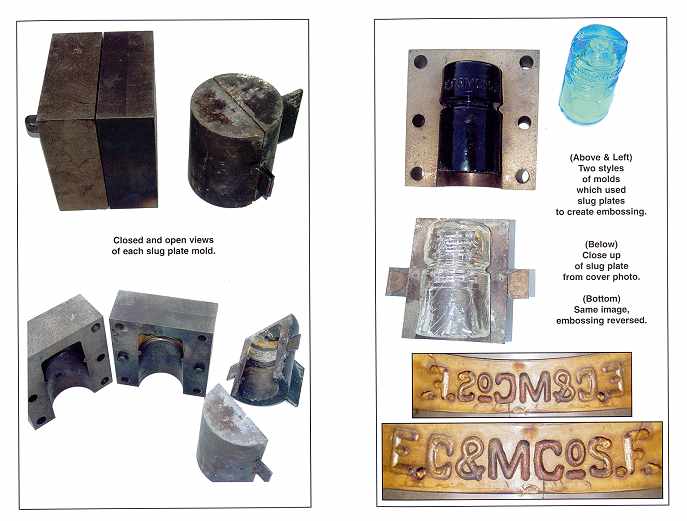
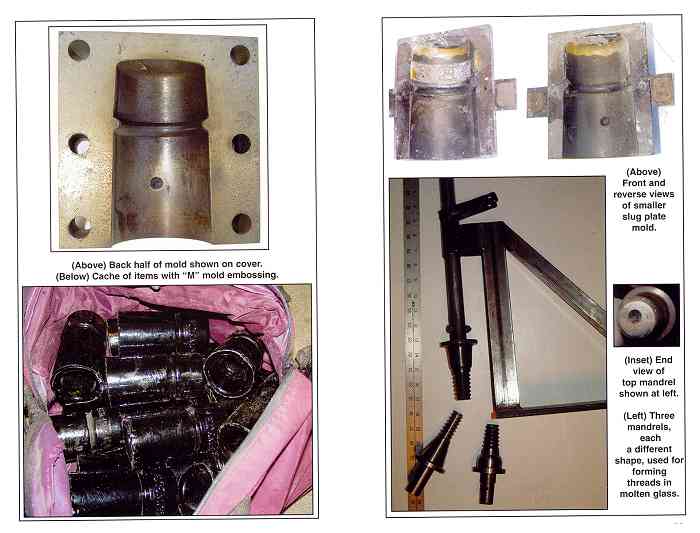
In October 2002, the A&C Committee was given the opportunity to inspect
the suspected molds and insulators. The A&C Committee inspected a cache of
EC&Ms. There were 29 green black glass "M-Mold" pieces; 8 clear
"J-Mold" pieces; 1 peacock "J-Mold" piece; a broken aqua
"M-Mold" piece; and a 30th green black glass "M-Mold" that
appeared to have been sandblasted to make it look old. In addition to the
insulators, the A&C committee observed three mandrels for making threads in
glass insulators, two of which were not for EC&Ms, one of which was; a well
made steel EC&M "M-Mold" (button on the reverse), which appeared
to have been re-worked, having been previously used to make "L-Mold"
pieces (button on the front); and a cruder steel mold similar to what has been
classified as a "J-Mold."
The A&C Committee had the opportunity to place "J-Mold" and
"M-Mold" pieces into the molds and noted that while the
"M-Mold" pieces fit, the "J-Mold" pieces did not. This has
led the A&C Committee to believe that the cruder steel mold may have been
used for another style of EC&Ms. No questionable CEWs were observed,
however, there was one questionable threadless, which had been broken in half.
There were several "Sierra Blocks." There was also a plaster cast of a
130.1 Cal. Elec. Works (which the DA accidentally and unfortunately broke).
The A&C Committee took 63 pictures documenting "the evidence."
(Presented are several pictures showing the insulators, molds, & mandrels.)
The molds, mandrels and insulators were then locked-up for safekeeping in a
police agency property locker. As a result of this inspection, the A&C
Committee formed an opinion and belief that the "J, L and M mold
EC&Ms" were Imitation Insulators (i.e. counterfeit, fake, etc.). Because
this now appeared to be a criminal matter (i.e. fraud, theft by deception, mail
fraud, etc.), a determination was made to keep this information confidential.
The U.S. Postal Inspectors were in fact
investigating the matter and requested the NIA's assistance in obtaining a list
of victims and documentation of their losses. They required documented losses in
excess of $100,000 in order to prosecute. To that end the NIA Board solicited
information regarding suspect insulators from collectors in the December 2002
issue of "Drip Points" and on "Insulator Collectors on the
Net" (ICON). In that same issue, the NIA Board provided a quick reference
guide to identifying "J, K, L, M and N mold style EC&Ms," (which
was also subsequently published in greater detail in the January 2003 issue of
"Crown Jewels of the Wire" magazine), and published its opinion and
belief that "J, K, L, M and N mold style EC&Ms" are Imitation
Insulators. The Board also made a determination that these particular insulators
were "objectionable to the best interests of the hobby" (i.e. likely
to cause financial damage and/or loss or injury to collectors or organizations
involved in the collecting of insulators, and the possibility of their use to
commit fraud)."
By the beginning of 2003, the NIA Board had collected what it believed was
enough information for the Postal Inspectors to proceed with their case, and
therefore turned that information over to them. The Postal Inspectors, through a
Federal Grand Jury Subpoena dated January 10, 2003, took possession of the
molds, insulators, and mandrels that were previously in the possession of the
Northern California DA's Office.
In response, the Dealers under investigation appeared to have started a
campaign of disinformation to try to "legitimize" the insulators that
the NIA had exposed. One Dealer also contacted several A&C Committee Members
with more threats of legal action,. not only against the NIA Board and A&C
Committee Members. but also against the collectors who were providing the Postal
Inspectors with testing samples. And, in the A&C Committee's opinion, these
Dealers staged a "new find" of another imitation EC&M. The
constant threats of litigation, and the pending criminal investigation by the US
Postal Service, unfortunately delayed the dissemination of information to the
NIA General Membership. The NIA Board was very aware that its Members wanted
answers and proof regarding the EC&Ms, but under the circumstances that
information needed to be withheld at that time.
In June of 2003, the Postal Inspectors informed the A&C Committee that
while the dollar amount for damages had been met, they were concerned about
criminal prosecution (which requires a higher burden of proof than civil
actions), because the majority of the transactions between the collectors and
the Dealers were conducted in cash and without receipts (like most hobbies).
They also informed the A&C Committee that the molds, mandrels and insulators
were being sent to the government's Dulles Forensic Laboratory for testing.
On August 11, 2003, the A&C Committee was advised that the U.S. Attorney reviewing the case was declining criminal prosecution at this time
due to the lack of documentary evidence (specifically lack of receipts tying the
victims to the Dealers). Although the U.S. Attorney had documentation for
$50,000 worth of purchases, the government's threshold to prosecute is currently
$100,000. The possibility for criminal charges against the two Dealers, however,
still remains.
On this same date the Postal Inspector advised the A&C
Committee that the Dulles Forensic Laboratory had completed preliminary testing
on one of the molds. and had determined that it was of modem production and not
antique at all. That mold was also determined to be the mold from which a
peacock blue EC&M was made. The Postal Inspector went on to indicate that
the evidence that the insulator was a fake was "incontrovertible." It
is also Dulles' opinion that the mandrels and insulators are of recent
production. The A&C Committee believes that a report will be written by
Dulles detailing their observations and will be available at a later date. If
the A&C Committee is able to obtain a copy of that report (it may be
withheld due to the ongoing Postal Service investigation), it will publish it in
a future "Drip Points."
The A&C Committee has also learned from
the government's forensic laboratory, that there are in fact scientific tests
available in the private sector that will definitively determine the age of
glass. The A&C Committee has received samples of various suspect insulators
(not just J, K, L, M and N mold style EC&Ms which, as mentioned above, the
NIA Board has already determined to be Imitation Insulators), and control
samples, donated by various collectors, which the A&C Committee will be
submitting to an independent laboratory for analysis. The results of these
independent tests will be published in "Drip Points."
In the meantime,
the government's forensic laboratory is sending the seized insulators, mandrels
and molds back to the Postal Inspector handling the case to preserve the chain
of custody, and for safekeeping until more documentary evidence is obtained.
This evidence would also be available through subpoena to anyone (or any group
of individuals), pursuing a civil action against the Dealers. Also, if any
collectors come across J, K, L, M and N mold style EC&Ms for sale, they
should immediately notify the NIA's A&C Committee, who will in turn alert
the Postal Inspector. The Postal Inspector could then issue a "Cease and
Desist Order," which if violated, would result in immediate criminal
prosecution.
Respectfully submitted, Steven Marks, NIA First Past President
EDITOR'S NOTE
The opinion and accompanying photographs are being presented
to the membership of the National Insulator Association this month by its board
of directors. Crown Jewels felt the opinion is sufficiently important to be
presented to hobbyists as a whole.
Opposing views are welcomed by Crown Jewels, and will be published.
|