Porcelain Insulator News
by Elton Gish
Reprinted from "Crown Jewels of the Wire", November 1996, page 17
In November 1971 CJ, Jack Tod responded to an ever-growing number of
questions about the value of multipart insulators and why they were not in any
books:
“I know of no collector who is attempting to make a general collection of
the multipart styles. He would have to own his own railroad train to mail them
and an unused astrodome to house his collection. There has been a never-ending
stream of different multis made by over a dozen large porcelain companies in the
past 75 years, and I would guess there would be over 1,000 major different
designs. It would take a room of draftsmen all year just to draw them all, and
you couldn’t lift a book with a style chart listing them all. True, most
collectors do save a few select multiparts if they are old, pretty and small.
And you might even want one of the very large ones around if you need a sturdy
stepladder, footstool or a birdbath for the back yard.”
Jack’s comments spurred a few letters from avid collectors who thought the
larger Fred Locke multiparts were well worth keeping. They were right of course
and Jack occasionally found a new term for them such as “boat anchors”. In
all fairness, no one knew anything about multipart insulators for many years,
and few collectors and even fewer dealers considered them worth bringing home or
taking to shows. Besides where would someone find the room to display very many
insulators each of which could easily weigh as much as 50-80 unipart insulators
and take up space needed for a growing porcelain collection? This part of the
hobby remained nearly nonexistent for many years until my book, Multipart
Porcelain Insulators, was published in 1988. The book was in response to a
growing demand for information about this fast growing segment of our hobby.
This part of the hobby has grown to such a point that the primary interest of at
least two collectors is multipart insulators, and nearly every porcelain
collector now has several “boat anchors”. In fact, at least ten styles of
multipart porcelain insulators command much higher values than the highest
valued threaded unipart porcelain insulator!
For many collectors, the true
excitement of the hobby comes from adding a new multipart insulator to their
collection. Great old classic multiparts from 1905 to 1930 are still being found
today in variety and new styles are showing up all the time — about 190 new
styles since my book was published. There are about 545 M-styles (about half of
Jack’s 1971 estimate) and many of these have not been found yet. This part of
the hobby is new and exciting. People can still find them along old power lines,
in abandoned substations, at power company storerooms, in front yards and flower
beds, and by making friends with linemen who are taking them out of service.
It is my pleasure this month to show you several unique and interesting
recent “finds” that exhibit what is still out there or, quite possibly, the
potential of insulator styles yet to be discovered. Few new glass insulators
have surfaced in recent years and, when they do, people are suspicious that the
new insulators are fakes. Not true with the relatively new segment of multipart
porcelain insulators.
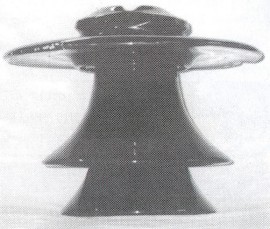
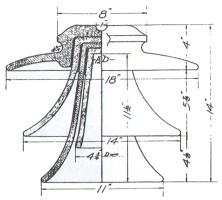
Jeff Kaminski (NIA #3582) sent a photograph of an very rare insulator. It is
the only known specimen of M-4800. Note the fourth skirt is recessed inside the
third skirt. The incuse THOMAS marking is stamped on the crown and under the top
skirt! Jeff’s main collecting interest is multipart porcelain and this
insulator quickly became his favorite and most sought after style. I remember
seeing the insulator for the first time at the Allentown National in 1989 —
the greatest national show ever for porcelain insulators. Mike Guthrie (NIA
#3297) bought the M-4800 and was unloading it from the back of a truck. It was
an awesome piece to see in person with the 18-inch diameter flat top skirt. It
was passed on to Bill Rohde (NIA #1219) and finally to Jeff. M-4800 was first
cataloged in the 1907 Locke catalog and appeared later in the 1917 Parker
catalog. This Thomas specimen was made in the 1910’s.
 |
 |
|
M-4800 Thomas
(18 - 14 - 11 - 5 x 14)
|
Walter Ruedrich (NIA #3290) displayed an interesting insulator on his table
at the Visalia Regional show in September 1995. Walter found the insulator while
insulator hunting in northern California near the famous Bay Counties line which
used M-2795’s. For those of you not familiar with M-2795, it is the Fred Locke
style with the porcelain spout and eaves-trough top skirt and a glass bottom
skirt made by Brookfield. Walter’s insulator had a top skirt identical to
M-2842 and the bottom skirt was probably the same glass skirt used for M-2795!!
As you can see in the photograph, most of the glass skirt was broken out. The
remaining glass is held firmly in place by the original sulfur cement! No
complete specimen of this new style is known. This insulator has been assigned
M-2842A. M-2842A was described in Fred Locke’s 300 series “Victor”
insulators as No. 317 (see page 105 in my book, Fred M. Locke: A Biography).
Following are the other three styles in the 300 series which was cataloged as
having a 10-1/2 inch top skirt: No. 316 (M-2795), No. 318 (M-2796), and No. 319
(M-2842).
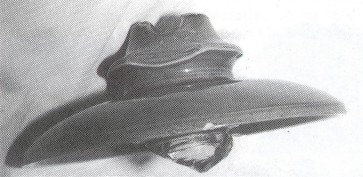
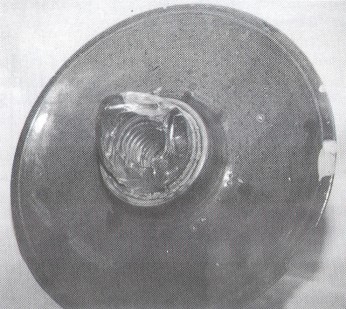
M-2842A (11 - 6.5 x 10) with Fred Locke incuse marking #6-2.
Note the broken
glass bottom skirt and original sulfur cement.
Before this past summer, Jim Sinsley (Coeur D’Alene, ID) acquired a small
collection of porcelain insulators and offered them for sale by a limited open
bidding system. Two of the insulators were extremely rare — one because of
glaze color and the second one for its rare marking and glaze color. Color
photographs of both insulators can be viewed on the insulator web page at http://www.insulators.com.
The first insulator was an unmarked Thomas M-3250. Only three of this style
were known before Jim’s discovery. These were reported in the May 1994 issue
of CJ on page 15. What makes Jim’s rare M-3250 even more desirable is the
glaze color which is unique from the previous three specimens. The glaze is a
beautiful mottled orange and mustard yellow color. The original wooden pin is
still stuck in the pinhole and sawed off flush with the bottom skirt. The thick,
flared wooden pin leaves less than 1/2" gap around the skirt. Evidently
this insulator was used inside a substation because of the condition of the pin
and the factory-new appearance of the insulator.
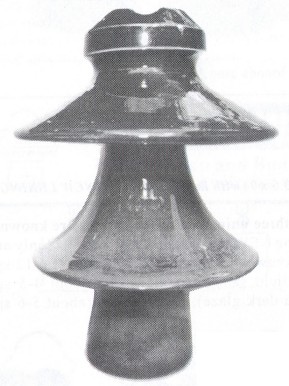
M-3250 N-N Thomas
(10 - 9 - 4 x 13.5)
The second insulator Jim had was even more rare. It was assigned the new
style number of M-2260B. What makes this insulator so rare is the incuse marking
NEW LEXINGTON, O. across the shoulder of the top skirt! The glaze color is a
beautiful light, highly speckled, sandy tan with a small amount of darker tan
mottling identical to most U-746’s with this same marking. Only four other
multipart styles are known with the New Lexington marking: M-2140 (one known),
M-2440 (one), M-2637 (one), and M-2841 (two). Each multipart style has a
different glaze color (nearly black, mahogany, and light and dark tan) but none
of them have the beautiful glaze found on M-2260B.

M-2260B (7 - 3.5 x 7) with incuse marking “NEW LEXINGTON, O.”
Only three unipart porcelain styles are known with the incuse marking NEW
LEXINGTON, 0.: U-552 (only one known but I do not know who owns it), U-746
(about 8-12 specimens known with light sandy tan glaze and about 4-5 specimens
known with a dark glaze), and U-966A (about 5-6 specimens known).

Left: M-2254 with incuse marking LIMA, N.Y. (7 - 3.5 x 6.5)
Center: M-2260B with incuse marking NEW LEXINGTON, O. (7 - 3.5 x 7)
Right: M-2260 N-N Thomas (7 - 4 x 7)
| 


)
)
)
)
)
)
)