Radio Strains aren't as bad as they sound!
by Dan Howard
Reprinted from "Crown Jewels of the Wire", November 1996, page 7
Introduction
I had been collecting radio antenna insulators and lightning arresters for
about fifteen years when I was informed that what I really collected was “radio
strains” - truly a name that only a mother could love. Well, I am pleased to
have this opportunity to take a break from my other “job,” editing Old
Familiar Strains, a collector’s newsletter, and show you that radio strains
aren’t as bad as they sound.
History
The history of antenna insulators starts with the history of radio itself.
Just before the turn of the century, the radio pioneers began demonstrating
their new science. In order to work properly, most antennas must be elevated
above surrounding objects and must be insulated from the ground. Radio antenna
insulators provide a means to suspend the antenna and insulate it. [Somehow it
just seems fitting - pin insulators were an outgrowth of telegraphy - radio
strains an outgrowth of wireless telegraphy].
Radios and crystal sets did not become commonplace in homes until the mid
1920’s. As a consequence, the earliest examples of radio antenna insulators
(dating from the teens) originate from military, commercial, or amateur radio
installations.
As would be expected, the same materials that were proven in use for
telegraph and power work were found to make good insulators in low frequency
radio work. Early insulators were commonly made from wood, mica, rubber, and
composition. Later, porcelain, glass, and finally fiberglass and plastic were
used.
Most of the examples of non-military insulators found today date from the
1930’s. The popularity of short wave listening in the 1930’s and during
World War II resulted in the sales of lots antenna insulators and antenna kits.
An antenna kit typically included antenna wire, a pair of end insulators, some
type of lead in, a lightning arrester, a ground strap and installation
instructions. Figure 1. shows a home installation.
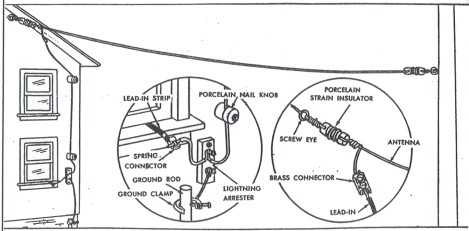
Figure 1. Wards Airline Antenna Kit, Part No. 62-422
Although antenna insulators are still used by amateur radio operators, and
you can still find them at electronics stores, two events from the 1950’s
spelled the decline for outdoor antennas and antenna insulators. First, for many
families the radio cabinet in the living room and the evenings spent listening
to radio programs were displaced by the television in the 1950’s. Second, the
development of improved in-cabinet radio antennas meant that most local stations
could now be picked up without using an outdoor antenna.
Types of Radio Antenna Insulators
Although there are specialists among antenna insulator collectors, the
generalists among us usually include the following items in our collections:
end insulators
As shown in Figure 1., end insulators are used to support the ends of a wire
antenna. Most have a hole through each end and sizes range generally from
1" up to about 12". (I once saw a 5 footer!) Although designs differ,
there are two main types; those that work in tension and those that work in
compression (see Figure 2.).
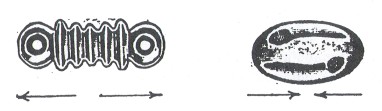
Figure 2. Illustration from “Allied Radio Catalog #110”,
1943, Chicago,
IL, pg. 56.
End insulators were made by hundreds of domestic manufacturers and the
variety of styles is immense. Unfortunately for collectors, more often than not,
the insulators were not marked with a name or trademark, making identification
difficult.
feed line insulators
The line that connects the outdoor antenna to the radio is called a “feed
line” or a “lead in.” Collectors use the term stand-off insulators to
describe the insulators that hold the feed line out away from the wall. In
function, a stand off insulator is similar to a small pin insulator. (See Figure
1.). Feed through insulators are sometimes used to bring the feed line through
the wall into the house. These are similar to the “knob and tube” insulators
that were once used for house wiring.
Lightning Arresters
Lightning arresters provide a path for lightning to get to ground without
(hopefully) following your antenna into the house, the radio, the dog, you, etc.
A lightning arrester is shown in Figure 1.
There are three main types of arresters. The most common style for radio work
has two “binding post” connections on the top. The second type has three
binding posts and is called a “doublet”. A third general type is specially
designed for use with television feed line. The television type usually
incorporates special grooves to hold various types of “twin lead.” All three
types are similar in function and construction. Most arresters were made of
porcelain. Some types from the 1930’s were made of clear glass. Others, from
the 1950’s were made of bakelite or other plastics.
Lightning arresters were frequently made by the same companies that made
antenna insulators. As mentioned above, arresters often came packaged together
with insulators in antenna kits.
Collecting Antenna Insulators
Talk about a young hobby. Our hobby newsletter, Old Familiar Strains, was
launched about three years ago. That endeavor marks the beginning of our efforts
to get organized as a collecting community. (And we are still far from
organized). When the newsletter started, many of the readers had been collecting
for years with little or no previous contact with other collectors!
One of the missions of Old Familiar Strains, is to promote the exchange of
information about our collections so that we can build a cataloging system. It
is hoped that, one day, a system similar to the ones that exist for cataloging
pin insulators will be developed for strain insulators.
Your first radio strain will probably be a 2 to 3 inch glass or porcelain
insulator found at a yard sale or at a flea market. But, don’t waste your time
looking at antique shops.
On a recent trip to southern California, we stopped at a few antique shops
along Interstate 5. Always the optimist, I answered honestly when the proprietor
of one shop asked “What are you looking for?” After repeating myself slowly
several times, I think that he finally began to understand that I was looking
for “those funny glass jobbies that folks used to use to hold up radio
antennas out on the farm.” Then he related the oft �told tale of the “bucket
full” that he threw out because “nobody wants them.”
Conclusion
If radio antenna insulators (okay, strains), look like they would be fun to
collect you are right! See, I told you that they weren’t as bad as they
sounded.
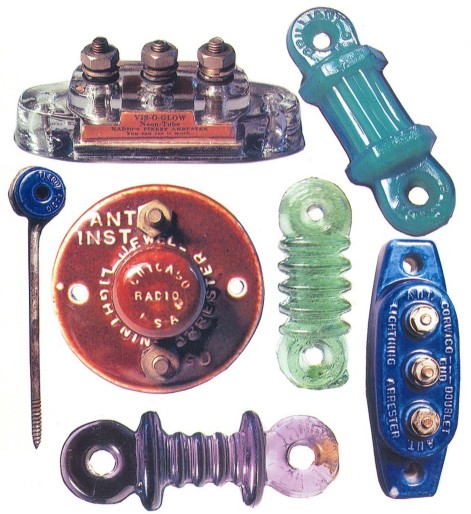
(from the cover)
(from the article)
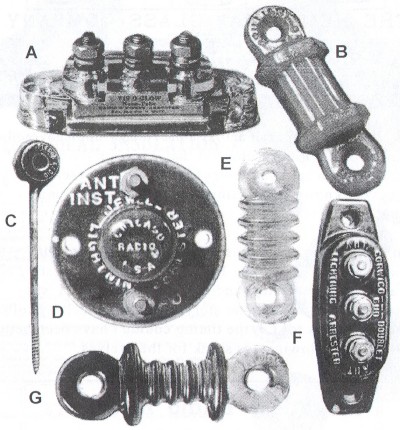
ON THE COVER: B, E and G are all glass end radio
antenna insulators while C is a feed line stand-off insulator.
A, D and F are lightning arresters. A is a
"doublet" glass lightning arrestor; while D and F are
made of porcelain and are the two "binding post" style and the
"doublet" style respectively.
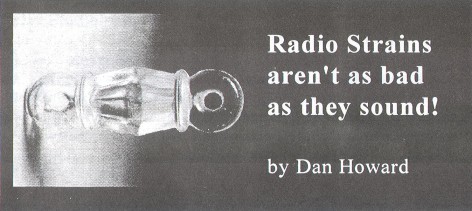
The beauty of the "faceted-looking" clear glass end
insulator serves as header for this article.
| 


)
)
)
)
)