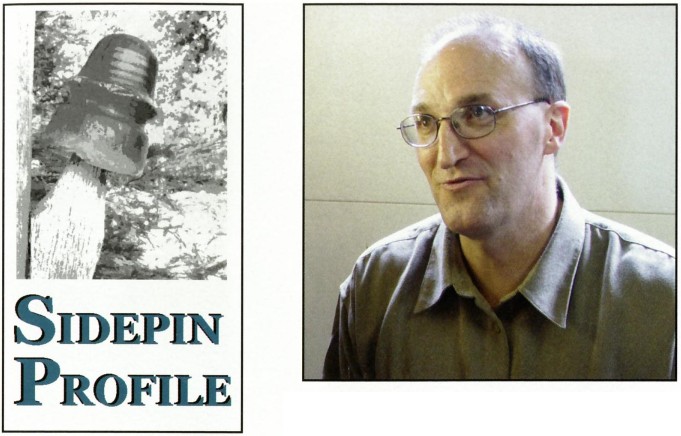
Sidepin Profile
By Michael Swanson
Reprinted from "Crown Jewels of the Wire", December 2005, page 36
Why I Collect Insulators
As with many insulator collectors, it all began in the 60's for me as well. I
always enjoyed road trips with my folks because it meant I would be able to gawk
at all the colored insulators on the seemingly endless procession of telephone
poles lining any roadway or railroad track in that era. I marveled at the
shapes, sizes and colors of glass - and porcelain - and all the different pins -
side pins, wooden pins, metal pins, multiple pin transposition brackets. In
spite of my interest, because I was a child, insulators seemed so inaccessible.
I had yet to see one close up, much less touch one.
Then, in 1964, I finally found my first piece. It was a porcelain signal left
on the ground next to a utility pole on the block where my grandmother lived in
Hillsboro, Oregon. The same year, I bought my first glass insulator from a
classmate - for $2.00 - a Hemingray-42 in green-aqua securely attached to a drop
bracket. Other acquisitions from friends included a green CD 210 Postal, my
first purple - an SCA Postal beehive, and aqua CD 164 HG Co. The following year
was particularly exciting. I spied a GTE telephone truck across the street from
my home in Hillsboro, made friends with the lineman, and he happened to have
insulators in his maintenance truck! He was all too happy to get rid of this
junk - a dark aqua CD 121 AT&T and a light aqua CD 133 Brookfield - my first
CREB - with an 1870 patent date! About monthly, I would ride my bicycle to the
Portland General Electric substation on Hillsboro's west side and add new
pieces. One I remember in particular was a grayish-green CD 164 McLaughlin.
Local searches included finding an aqua Hemingray-8 along Walker Road in
Beaverton, not far from my grandparent's home and aqua Brookfield ponies.
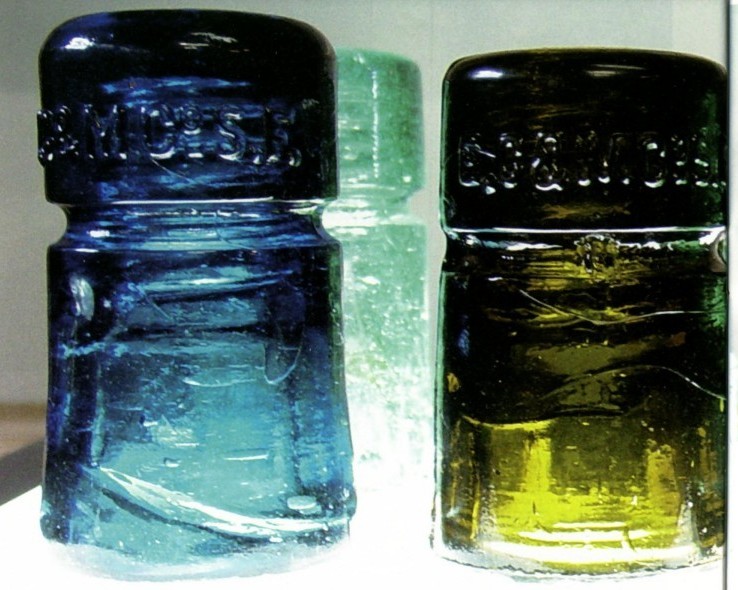
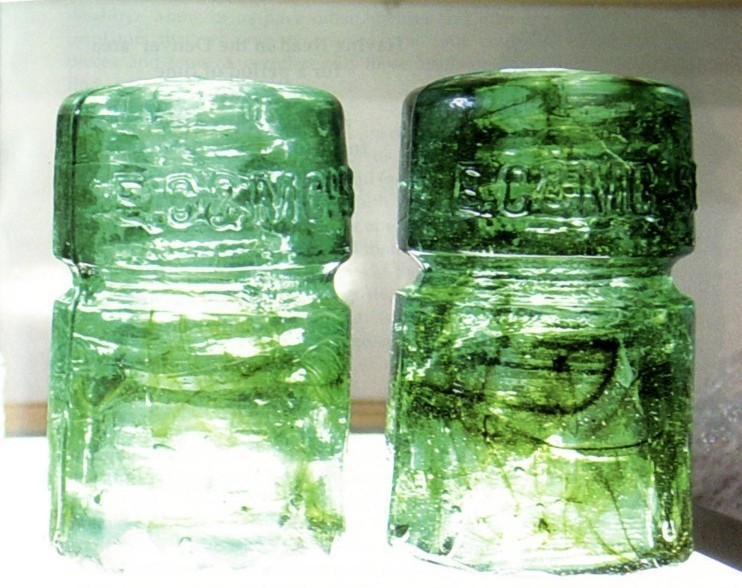
EC&M's are among Mike's favorite insulators.
This lineup was part of a
joint display at a swap meet.
Mike owns the CD 123's at the far left (upper photo)
and far right (lower photo).
The telephone company even placed a clear and aqua Hemingray-42 in a tree,
just a few blocks from my home. Trips to Nebraska in our VW bug for summer vacation were also ripe with opportunities to acquire new pieces.
Telephone and telegraph lines were beginning to come down in many areas. I
literally saw a rancher loading crossarms full of insulators into the back of
his pickup truck along the UPRR tracks in Wyoming. Nearly every farmer and
rancher had crossarms in their barns or somewhere on their property back then.
Of course, they were more interested in the crossarms to be used as fence posts
rather than the attached glass.
I soon discovered OBX magazine, which contained many interesting insulator
articles and I discovered there were other strange people out there who shared
my obsession. My seventh-grade teacher collected insulators and loaned me her Milholland
book. I also had the privilege of meeting fellow collector and
author Francis Terrill, and I was just in awe seeing her collection! Two of my
classmates also collected and we traded with each other and went on several
local collecting excursions together.
As the 1970's progressed, my interest in collecting faded some as I graduated
from high school and embarked on a military career. Then in 1980, the insulator bug bit me again. I had just been stationed in Colorado and I met many
wonderful collectors by attending Colorado shows, most of whom are still friends
today - among them are Mike Green, Duane Davenport, Keith Roloson, Tom and Lynda
Katonak, Mike Gay, Ray Klingensmith and Chuck Irwin, to name a few. And years of
collecting have introduced me to many other fine collectors and friends.
Today, my collection is small, but consists of pieces that are special to me.
I love to daydream about where my glass was used, what messages or conversations
passed through the wires attached to my insulator, who screwed the insulator
onto the wooden peg that secured my gem for all those years, etc. I like to
envision my piece actually in use, the snow, wind and electrical storms it had
to endure, and wonder when and how it was pulled from service? Was it carelessly
tossed to the ground and by some miracle survived the abuse? Or did a lineman
with forward thinking who himself collected, remove my jewel with loving care
and place it on his own shelf to be appreciated for years? Did my piece lay
buried under mud and pine needles before being discovered by someone with a
lucky metal detector, probe or shovel? I find it miraculous that these objects,
which are so fragile, were able to survive the elements and years of use and
abuse. Also, I enjoy knowing the history of an insulator acquired, if possible.
Also, knowing the person I purchase the piece from is also important. Recently,
I acquired a beautiful Brookfield insulator from Kevin Meehan, who painstakingly removed the piece from a line in Mexico at night, at great
personal risk.
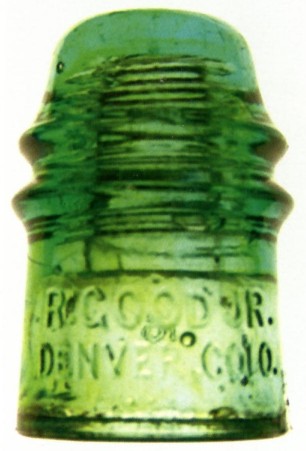
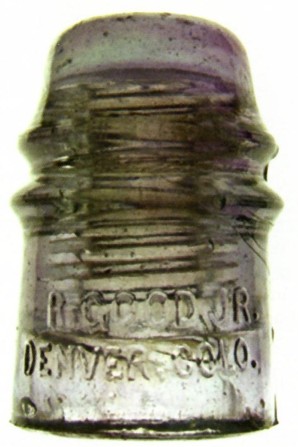
Having lived in the Denver area for a
period of time gave Mike a special
appreciation for insulators made there
some 100 years ago, especially items
with
unusual characteristics such as this
example wherein ambers swirls turned
an
otherwise aqua insulator into a
special green coloration.
Also, I've enjoyed hunting expeditions with many friends, making that
occasional special find. The stories behind the pieces make them extra special.
My personal favorite pieces are Denvers, CREBs, EC&M / Cal Elecs and H.G
beehives, but I appreciate all pieces, even if they happen to be more common.
Additionally, the unintended beauty of the glass is what I appreciate the
most. The manufacturers never once dreamed their product would someday adorn
collectors' light boxes or that there would be regional and national shows where
enthusiasts would come from far and wide just to exhibit their pieces and buy,
sell or trade. No factory worker ever thought, "let me put this chunk of
iron in the glass mixture because I know the piece will come out swirled."
No, our objects of desire were strictly produced for utilitarian purposes - even
the colored ones. To me, accidental beauty is far more valuable than someone
intentionally creating it. Here's a toast to poor quality control! From internal
bubbles and amber or carbon swirls and objects in the glass, to cold shuts,
annealing lines, open surface bubbles, to that one-or-two-of-a-kind oddball
piece that was never intended to be that color, to the pieces that slump to the
right or left, have underpours or overpours or other defects, insulators are
unique in the collecting world.
Likewise are those of us who collect them. For those of you who live in
Portland, Oregon or have visited this city, you know how diverse, and in some
cases, strange, some of the people are here. You will never see a broader
variety of unique people living in one geographical area than Portland. So it is
with insulator collectors. We are all a little bit different. Some of us are
poor, some wealthy. Many of us have other hobbies and interests. Some of us collect
insulators that are very expensive; some only collect so-called"
affordable" pieces, and some of us collect only those insulators that we're
lucky enough to find.
To mainstream America, insulators are common refuse, to be tossed out with
the household trash. But to those of us who see the beauty in the glass and
appreciate the job insulators once did (and in some cases, are still doing) and
the effort expended by rugged telegraph construction crews to construct a line
through miles and miles of forest or open range or steep mountain terrain, in my
opinion, there is no more beautiful man-made object. And while there may be as
many reasons to collect insulators as there are collectors, insulators are the
tie that binds us all together. As nice as the glass (or porcelain) may be, what
makes collecting special is that commonality we all have that enables us to
connect with each other. Were it not for all the great collectors out there,
insulator collecting would not be nearly so enjoyable.
I want to thank all those fellow collectors out there who are friends, have
shared their lives and collections with me, or who simply may have purchased an
insulator from me. My wish is that the insulator hobby will continue to thrive
for years to come and that everyone will derive the same enjoyment from the
hobby that I have. As one collector so aptly stated, "We are simply the
caretakers for these beautiful objects during our time on this earth." And
this is true. May collectors of the future also develop the same appreciation
for insulators as those of us who are collecting today. Long live the insulator
hobby!
|